The experiment in plain words
We kept the same candidate principle: patterns that change less across connections express more strongly. Then we changed which participants were connected and checked whether the expression still stayed concentrated in the same assigned positions.
We used the original cycle, an open chain, a network with four local links per participant, and four levels of degree-preserving rewiring. Each rewired family used five fixed seeds. Two inputs, four selectivities, and five evolution positions produced 920 configurations.
The graph changes the L used in both evolution and admission. The forms of those rules stay fixed; the numerical operators change with the graph. Every network also receives its own all-mode baseline. The position map is held fixed throughout.
The main result
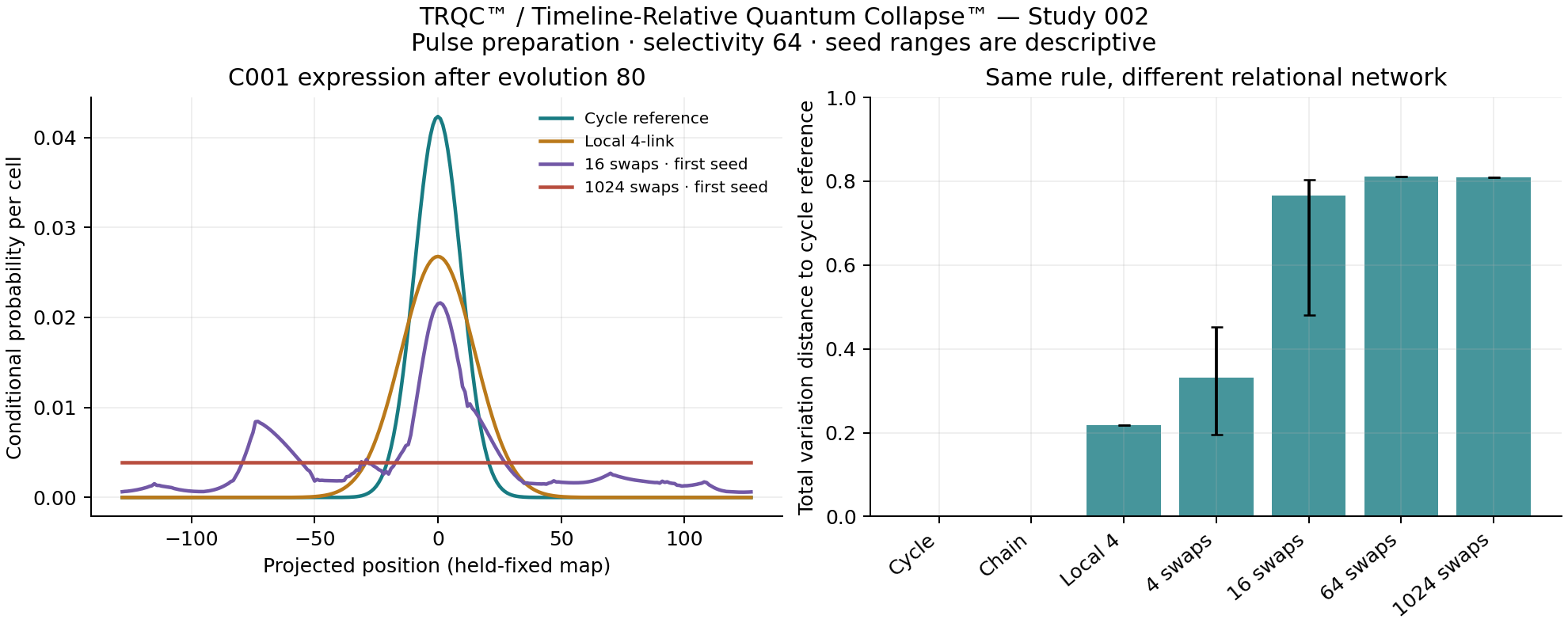
Local connections retained a concentrated expression at the displayed preset. Extra local links made it wider. Rewiring increasingly spread the expression into remote positions. With strong rewiring, it became almost even across the whole position map.
| Network | Spread · model cells | Difference from cycle | Raw expressed share |
|---|---|---|---|
| Original cycle | 9.425 | 0.000 | 2.495% |
| Open chain | 9.425 | 0.000 | 2.495% |
| Local four-link | 14.897 | 0.218 | 1.578% |
| 4 swaps | 29.060 · range 16.29–41.85 | 0.332 | 1.088% |
| 16 swaps | 65.928 · range 48.81–75.34 | 0.766 | 0.436% |
| 64 swaps | 73.933 · range 73.90–74.28 | 0.811 | 0.391% |
| 1024 swaps | 73.900 · range 73.90–73.90 | 0.810 | 0.391% |
“Difference from cycle” is total variation between normalized position distributions: 0 means identical and 1 means disjoint. These are the displayed preset's results, not a summary of every input and selectivity. The complete sweep is in the downloads.
Why it happened
A pattern that is the same at every participant has zero mismatch across the connections. C001 therefore admits that constant pattern fully. At the displayed selectivity, strongly rewired networks suppress most other patterns and leave that nearly uniform expression.
What we learned
Being smooth across connections is not enough to keep a localized packet under this position map. The original packet depended on how the supplied network and assigned positions fit together. That points us toward the expression map or a different compatibility rule as the next place to investigate.
Wide distributions reach the edges of the chosen position range. Their spread measures describe that fixed coordinate cut. Seed ranges describe the five sampled graphs; they are not population confidence intervals.
Checks and complete records
The study's numerical controls passed. Four predetermined networks were cross-checked with direct matrix exponentials. Conservation, channel accounting, eigendecomposition, and consistent relabeling were also checked. A fresh local rerun reproduced the saved graph and metric records and all state arrays; the downloaded record identifies that as a local reproduction check.
The protocol, seeds, graph definitions, complete metrics, and underlying/expressed/unexpressed complex amplitudes are retained. Each CSV data row matches the same row in each state array.
- Prior-defined study protocol
- All 920 configuration records · CSV
- Complete complex state arrays · NumPy archive
- Every graph's edges and weights
- Numerical results and check errors
- Saved local reproduction record
- Download integrity hashes
The next question
Can a position expression defined from the relations themselves retain useful localization, or does admission need a different compatibility principle? This question is recorded as planned work. No additional candidate or completed experiment is being claimed.